•
2026/07/13•HEMSCap Content Writer
The Role of AI Coach for Physical Therapy in Modern Rehabilitation
Introduction
In recent years, artificial intelligence has rapidly entered the healthcare industry, reshaping how rehabilitation and clinical care are delivered. One of the most impactful innovations in this space is the AI Coach for Physical Therapy, a system designed to support both patients and clinicians throughout the recovery process.
Unlike traditional methods that rely heavily on in-person supervision, AI-driven coaching systems can analyze movement, provide real-time feedback, and personalize rehabilitation programs. This shift is especially important as healthcare systems move toward hybrid and remote care models.
Platforms such as HEMSCap demonstrate how AI coaching technologies are already being applied in real clinical environments, helping physical therapists deliver more efficient and data-driven care.
As healthcare systems increasingly face higher patient loads and limited clinical time, digital tools like AI coaches are becoming essential in supporting scalable rehabilitation services.
These systems are particularly valuable in physical therapy, where consistent repetition and correct movement execution directly influence recovery outcomes.
Recent advancements in computer vision and machine learning have made it possible to accurately analyze human motion using only standard cameras or mobile devices.
This technological progress is enabling a shift from traditional supervised sessions to continuous, home-based rehabilitation supported by intelligent digital coaching systems.
What is an AI Coach for Physical Therapy?
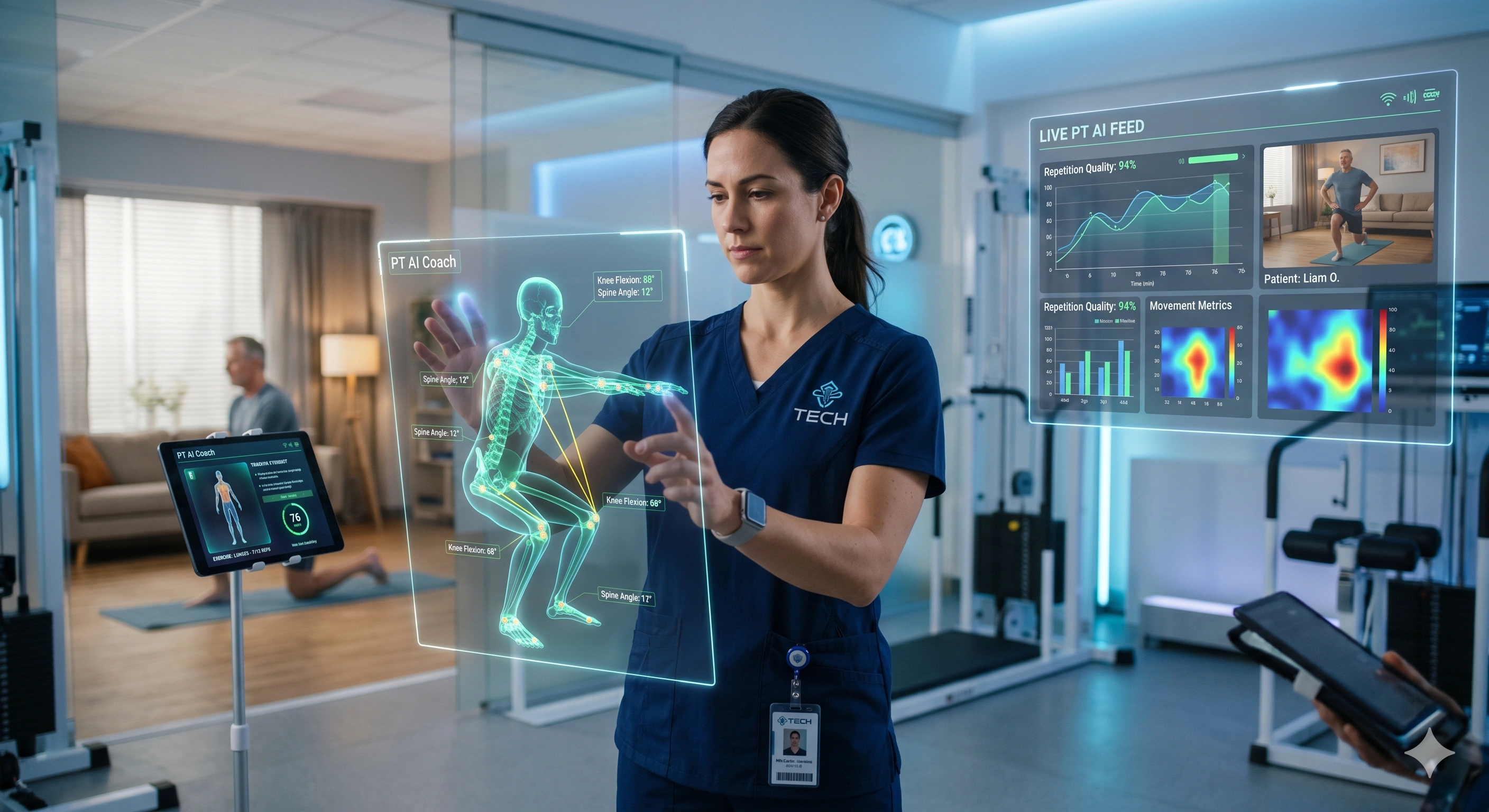
An AI Coach for Physical Therapy is an intelligent digital system that assists in guiding rehabilitation exercises using artificial intelligence, motion tracking, and machine learning algorithms. Its primary goal is to improve patient recovery by providing continuous monitoring and personalized feedback.
Instead of replacing clinicians, it acts as a supportive layer between the patient and the therapist, enhancing decision-making and ensuring exercises are performed correctly.
Key Functions of AI Coaching Systems
- Real-time movement analysis
- AI systems can detect incorrect posture or movement patterns during exercises and provide immediate corrections to the patient.
- Personalized rehabilitation programs
- Treatment plans are dynamically adjusted based on patient progress, recovery speed, and performance data.
- Automated progress tracking
- Clinicians receive structured reports that summarize patient adherence and improvement over time.
How AI Coach for Physical Therapy is Transforming Rehabilitation
The integration of AI coaching systems into physical therapy is fundamentally changing how rehabilitation is delivered.
Improved Patient Adherence
One of the biggest challenges in physical therapy is ensuring patients consistently perform their home exercises. AI coaches improve adherence by offering real-time feedback, reminders, and motivational guidance.
Reduced Clinical Workload
Documentation and patient tracking often take up a significant portion of a therapist’s time. AI automation reduces this burden by generating progress reports and treatment summaries automatically.
Remote Rehabilitation (Tele-rehab)
AI coaching enables patients to receive professional guidance without physically visiting a clinic. This is especially valuable for patients in rural or underserved areas.
HEMSCap as a Real-World Example of an AI Coach
HEMSCap is an example of a modern digital rehabilitation platform that incorporates AI coaching principles into physical therapy workflows. It uses computer vision and motion analysis to evaluate patient movement and deliver actionable feedback.
Core Capabilities of HEMSCap
- Real-time motion tracking using AI algorithms
- Digital exercise prescription and monitoring
- Remote patient supervision and tele-rehabilitation support
- Automated clinical documentation for therapists
HEMSCap illustrates how AI Coach systems can bridge the gap between in-clinic therapy and home-based rehabilitation, creating a continuous care environment.
Benefits of AI Coach for Physical Therapy
The adoption of AI-driven coaching systems offers several important advantages in modern healthcare.
- Enhanced treatment accuracy
- AI systems provide objective movement analysis, reducing human error in assessment.
- Lower healthcare costs
- Reduced need for frequent in-person sessions can significantly decrease overall treatment costs.
- Greater accessibility
- Patients can access high-quality rehabilitation services regardless of geographic location.
- Data-driven decision making
- Clinicians can base treatment adjustments on continuous performance data rather than periodic evaluations.
Challenges and Limitations
Despite its advantages, AI coaching in physical therapy still faces several challenges.
- Data quality dependency
- AI systems require accurate and consistent input data to function effectively.
- Privacy and data security concerns
- Patient movement and health data must be securely stored and processed.
- Technology adoption barriers
- Some patients and clinicians may struggle with adapting to digital tools.
The Future of AI Coach in Physical Therapy
The future of AI coaching in rehabilitation is highly promising. As technology advances, AI systems are expected to become even more intelligent and integrated into clinical workflows.
Potential developments include:
- Predictive injury risk analysis
- Fully adaptive rehabilitation programs
- Integration with wearable sensors and robotics
- More advanced human-AI collaboration in clinical decision-making
These innovations will likely make rehabilitation more proactive, personalized, and efficient.
Academic Reference (Google Scholar)
Research has shown that digital rehabilitation systems powered by artificial intelligence can significantly improve patient engagement and treatment outcomes. A study published in the Journal of Medical Internet Research highlights that digital interventions in rehabilitation improve adherence and clinical effectiveness compared to traditional care models.
Final Thoughts
The AI Coach for Physical Therapy represents a major shift in how rehabilitation is delivered and managed. By combining artificial intelligence, motion tracking, and personalized feedback systems, it enhances both patient outcomes and clinical efficiency.
Real-world platforms like HEMSCap demonstrate that AI coaching is not just a theoretical concept but an active part of modern healthcare innovation. As adoption increases, AI-driven rehabilitation is expected to become a standard component of physical therapy practice.
The adoption of AI Coach systems in physical therapy is also influencing how clinicians design long-term rehabilitation strategies. Instead of relying only on periodic check-ins, therapists can now observe continuous data trends and make more informed adjustments to treatment plans.
This shift toward data-driven rehabilitation supports earlier detection of plateaus or regressions in patient progress. As a result, interventions can be modified in real time rather than waiting for the next clinical visit.
Another important development is the growing collaboration between AI systems and wearable technologies. When combined, they provide a more complete picture of patient movement and recovery patterns.
Clinical studies in digital health also suggest that hybrid care models—where AI tools assist but do not replace clinicians—tend to produce more sustainable recovery outcomes.
In practice, this means AI coaching works best as an extension of professional judgment rather than a standalone solution. Physical therapists still play the central role in diagnosis and treatment decisions.
Platforms like HEMSCap reflect this balance by focusing on clinical support rather than automation of medical decision-making. This ensures safety and maintains professional oversight.
As healthcare systems continue to evolve, regulatory frameworks are also being developed to ensure responsible use of AI in rehabilitation settings.
Overall, the future of physical therapy is likely to be a hybrid ecosystem where human expertise and AI-driven insights work together to improve patient care quality.
FAQ
1. What is an AI Coach for Physical Therapy?
An AI Coach for Physical Therapy is a digital system that uses artificial intelligence to guide, monitor, and improve rehabilitation exercises.
2. Does AI Coach replace physical therapists?
No. It supports physical therapists by automating monitoring and providing data-driven insights, but does not replace human expertise.
3. How does HEMSCap use AI in physical therapy?
HEMSCap uses computer vision and motion analysis to track patient movements and provide real-time feedback during rehabilitation.
4. Is AI coaching accurate in rehabilitation?
AI systems can be highly accurate when trained with quality data, but their effectiveness depends on proper implementation and clinical validation.
5. What is the main benefit of AI coaching in physical therapy?
The main benefit is improved treatment quality through real-time feedback, personalization, and continuous patient monitoring.