•
2026/07/08•HEMSCap Content Writer
AI in Physical Therapy: Transforming Movement Rehabilitation from Assessment to Remote Care
Introduction
In recent years, artificial intelligence has rapidly transformed the healthcare industry, and one of the most significantly impacted fields is physical therapy. The concept of AI in Physical Therapy is no longer theoretical; it is actively being implemented in clinics and home-based rehabilitation programs worldwide.
Physical therapists today face increasing pressure from large patient volumes, time-consuming documentation, and the need for continuous patient monitoring. AI-powered systems are addressing these challenges by improving clinical efficiency, enhancing decision-making, and expanding access to care.
This article explores the real-world applications of AI in physical therapy, highlighting how it is reshaping rehabilitation workflows and improving patient outcomes.
Over the past decade, advances in computer vision, wearable sensors, and machine learning have made it possible to collect and analyze movement data with unprecedented accuracy.
This technological progress has opened new opportunities for integrating AI-driven tools directly into rehabilitation workflows.
In many clinical settings, digital health platforms are now being used to complement traditional in-person physical therapy sessions.
These systems help bridge the gap between clinic-based care and home-based rehabilitation programs.
At the same time, the growing availability of patient-generated health data is enabling more continuous and personalized treatment strategies.
As a result, AI is becoming an increasingly important component in modern rehabilitation science rather than a supplementary tool.
What is AI in Physical Therapy?
AI in Physical Therapy refers to the use of artificial intelligence technologies such as machine learning, computer vision, and predictive analytics to enhance assessment, treatment planning, and patient monitoring in musculoskeletal and neurological rehabilitation.
Why it matters:
- AI improves the accuracy of movement analysis by identifying patterns that may not be visible to the human eye.
- It reduces administrative workload by automating repetitive clinical documentation tasks.
- It enables continuous care delivery outside traditional clinical environments.
Key Applications of AI in Physical Therapy
1. Motion Analysis and Biomechanics Assessment
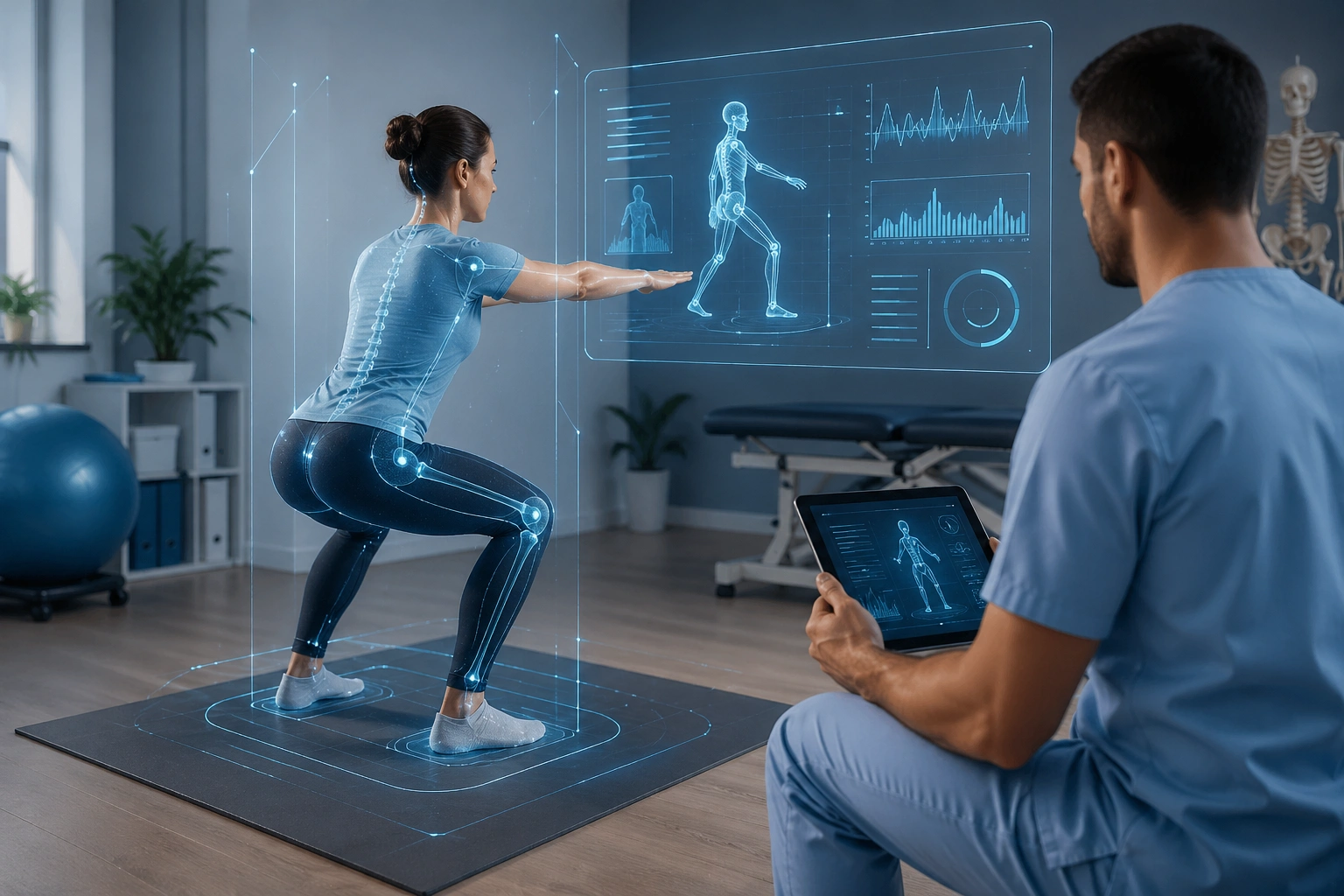
AI-powered motion analysis systems use computer vision to evaluate human movement in real time.
- These systems can measure joint angles, range of motion, and symmetry in movement patterns with high precision.
- They help clinicians identify abnormal movement strategies that may contribute to injury or delayed recovery.
This level of detailed biomechanical insight allows therapists to make more informed clinical decisions.
2. Remote Patient Monitoring (RPM)
AI enables continuous monitoring of patients outside the clinic environment through digital platforms and camera-based systems.
- Patients can perform prescribed exercises at home while AI tracks performance accuracy.
- Therapists receive real-time feedback data, allowing them to adjust treatment plans without in-person visits.
This approach significantly improves patient adherence and continuity of care.
3. Automated Clinical Documentation
Documentation is one of the most time-consuming tasks in physical therapy. AI helps automate this process.
- Systems can generate structured clinical notes such as SOAP notes and progress reports.
- This reduces administrative burden and allows clinicians to focus more on patient care.
Automation also improves consistency and reduces human error in clinical records.
4. Intelligent Exercise Prescription
AI systems can personalize rehabilitation programs based on patient-specific data.
- Exercise intensity and progression are adjusted dynamically based on performance.
- Real-time feedback ensures correct movement execution, reducing the risk of re-injury.
This personalization significantly improves rehabilitation outcomes.
Role of HEMSCap in AI-Driven Physical Therapy
One of the emerging platforms in this space is HEMSCap, which integrates AI technologies into a unified rehabilitation ecosystem.
Key capabilities of HEMSCap:
- Markerless Motion Tracking
Uses computer vision instead of wearable sensors to analyze movement patterns in real time.
- Integrated Rehabilitation Platform
Combines exercise delivery, patient monitoring, and clinical reporting into a single system.
- Remote Therapy Support
Enables therapists to manage patient recovery outside traditional clinical settings.
- Workflow Optimization
Automates repetitive administrative tasks, improving clinic efficiency and scalability.
HEMSCap represents a practical example of how AI is being applied in real-world physical therapy environments.
Benefits of AI in Physical Therapy
- Improved Clinical Accuracy
AI enhances diagnostic precision by analyzing complex movement data beyond human capability.
- Increased Efficiency
Automation reduces time spent on documentation and manual data processing.
- Expanded Access to Care
Patients in remote or underserved areas can receive continuous rehabilitation support.
- Enhanced Patient Experience
Real-time feedback and personalized programs improve engagement and outcomes.
Scientific Evidence Supporting AI in Physical Therapy
Research supports the growing role of machine learning in rehabilitation science.
A study published in the Journal of NeuroEngineering and Rehabilitation explored machine learning methods for predicting rehabilitation outcomes in stroke patients. The findings suggest that data-driven models can significantly improve clinical decision-making and help personalize rehabilitation strategies based on patient-specific recovery patterns.
This research highlights the increasing integration of artificial intelligence into evidence-based rehabilitation practices.
The Future of AI in Physical Therapy
The future of rehabilitation is expected to become increasingly data-driven and AI-assisted.
- Integration with electronic health records (EHR) will enable seamless data exchange.
- Predictive analytics will allow clinicians to forecast patient recovery trajectories.
- Digital therapeutics will become a core component of rehabilitation programs.
As these technologies mature, AI will continue to enhance both clinical efficiency and patient outcomes.
Final Thoughts
AI in Physical Therapy is fundamentally reshaping the way rehabilitation services are delivered. From motion analysis and remote monitoring to automated documentation and intelligent exercise prescription, AI is improving both clinical efficiency and treatment effectiveness.
Platforms like HEMSCap demonstrate that these innovations are not theoretical but actively being implemented in real clinical environments. The combination of human expertise and artificial intelligence is paving the way for a more precise, scalable, and accessible rehabilitation ecosystem.
Furthermore, the integration of AI into physical therapy is gradually shifting the field from reactive care to more proactive and preventive approaches.
Clinicians can now identify potential risks earlier by analyzing movement patterns and functional data over time.
This shift supports earlier interventions, which can reduce the severity and duration of musculoskeletal conditions.
AI also enables better collaboration between patients and therapists through continuous data sharing and feedback loops.
As digital health ecosystems expand, interoperability between AI platforms and clinical systems will become increasingly important.
Overall, these advancements suggest that AI will remain a long-term supporting tool in improving the quality and consistency of rehabilitation care.
Frequently Asked Questions (FAQ)
1. What is AI in Physical Therapy used for?
AI is used to analyze movement, monitor patients remotely, and automate clinical documentation.
It enhances both diagnostic accuracy and treatment efficiency.
2. Does AI replace physical therapists?
No, AI is a supportive tool and does not replace clinical expertise.
Therapists remain central to decision-making and patient care.
3. Is AI safe for rehabilitation patients?
Yes, when properly implemented under clinical standards, AI systems are safe.
Most platforms use secure data handling protocols to protect patient information.
4. Can small clinics use AI in physical therapy?
Yes, many AI-based tools are designed for clinics of all sizes.
They help smaller practices improve efficiency and compete with larger organizations.
5. What is the role of HEMSCap in AI-based rehabilitation?
HEMSCap is a digital platform that integrates AI for motion analysis and remote patient monitoring.
It serves as a practical example of AI applied in modern physical therapy workflows.