•
2026/06/06•HEMSCap Content Writer
Goniometry: Measuring Joint Range of Motion in Physical Therapy
Introduction
Accurate measurement of joint range of motion, or Goniometry, is a fundamental principle in evaluating patient function in physical therapy. This technique allows physical therapists to identify movement limitations, track patient progress, and create personalized treatment plans. Precise measurements are critical for diagnosing injuries, monitoring therapy outcomes, and improving clinical results.
With the advent of digital technologies and artificial intelligence, tools such as PivotalPT, HildaCoach, and GeniusPT have transformed the process of measuring and documenting joint range of motion, making it automated, precise, and trackable. This article provides a comprehensive overview of Goniometry, measurement techniques, clinical considerations, and the role of HEMSCap solutions in enhancing patient care.
What is Goniometry?
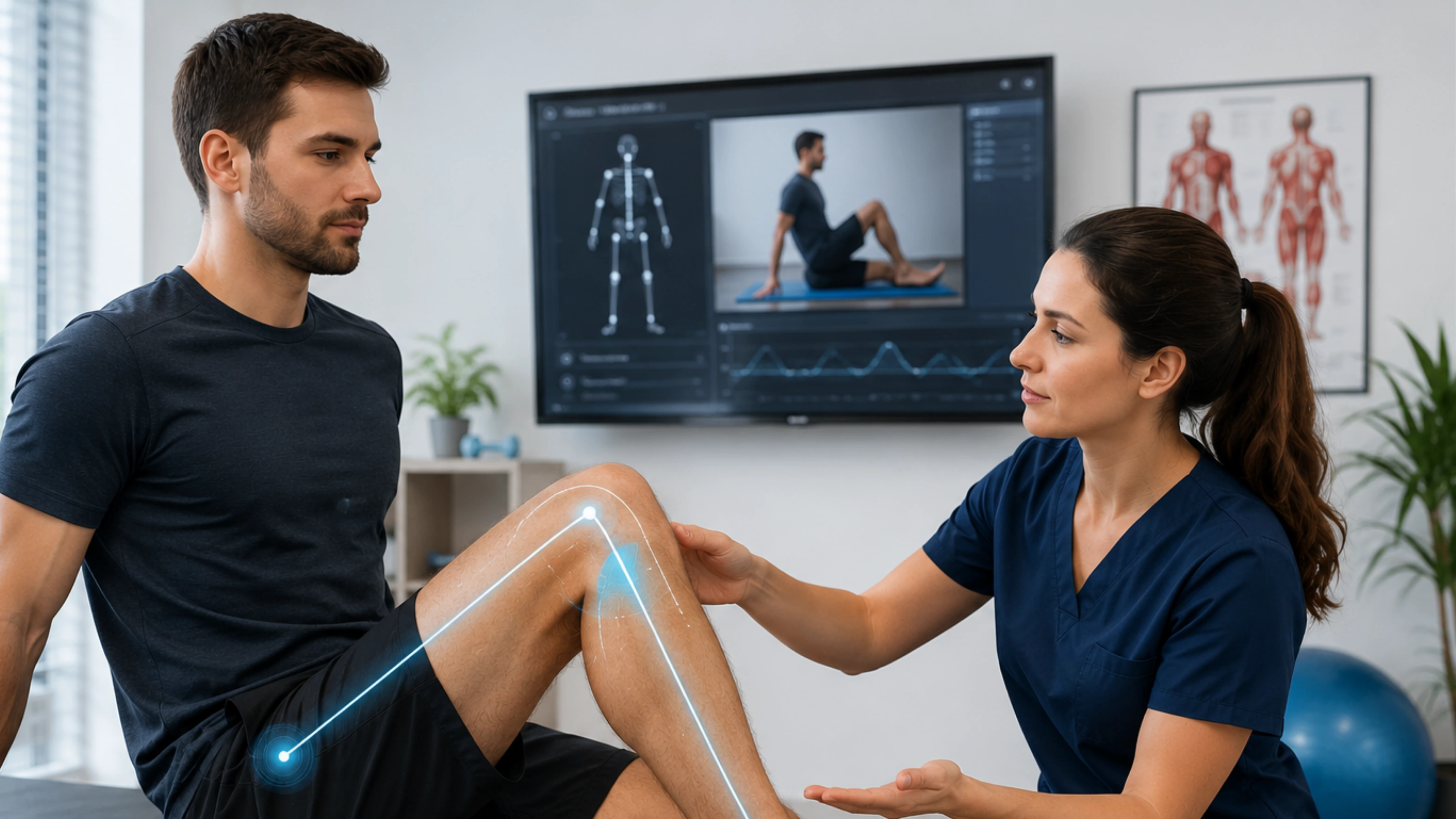
Goniometry refers to the measurement of joint range of motion (ROM), involving the assessment of the angle at which a joint moves in various directions. This technique is applicable to all joints, but it is most commonly used in physical therapy for the shoulder, elbow, wrist, hip, knee, and finger joints.
Clinical Importance
Accurate joint ROM measurement helps physical therapists to:
- Record and monitor functional changes over time: Tracking ROM changes allows therapists to evaluate treatment effectiveness and adjust plans.
- Diagnose joint restrictions and movement limitations: Identifies specific joints or motions that need intervention.
- Provide a basis for treatment planning: Offers objective data to design precise and targeted therapy programs.
- Personalize exercise and therapy programs: Enables creation of exercises suited to each patient’s unique limitations and needs.
For instance, measuring flexion and extension at the metacarpophalangeal (MCP) joints of the fingers is essential for identifying movement restrictions and tracking rehabilitation progress. Here, Goniometry plays a pivotal role in improving the quality of care.
Recent studies have demonstrated that digital and AI-assisted Goniometry systems can significantly improve the reliability and efficiency of joint range of motion assessment in physical therapy. Research published in Measurement in Physical Education and Exercise Science found that digital goniometers showed extremely high reliability and validity when measuring knee joint ROM, particularly in flexion and extension assessments. The study emphasized that digital measurement systems reduce human error, improve consistency between therapists, and provide more efficient documentation compared to traditional manual methods. These findings support the increasing adoption of AI-powered rehabilitation platforms such as GeniusPT, PivotalPT, and HildaCoach, which combine automated ROM analysis, digital documentation, and remote patient monitoring to enhance clinical outcomes and patient engagement in modern physical therapy practice.
Goniometry Techniques
Tools and Equipment
Common tools for Goniometry include:
- Manual goniometer: Traditional, portable tool for measuring joint angles
- Inclinometer: Provides more precise, often digital, measurements
- Digital and AI software: Modern tools such as GeniusPT and PivotalPT, which automate measurements and streamline data recording.
Measurement Steps
- Patient positioning: The patient is placed in a proper position to allow unrestricted joint movement.
- Axis placement: The goniometer axis is aligned precisely with the joint center.
- Stationary and moving arms: The stationary arm is placed on the fixed bone, while the moving arm follows the moving bone.
- Angle reading: The joint angle at the end of the range is read and recorded.
- Documentation: Results are documented for tracking patient progress.
Digital tools from HEMSCap, such as GeniusPT, increase accuracy, reduce human error, and allow longitudinal tracking of joint range of motion.
Clinical Applications of Goniometry
Goniometry is widely used in physical therapy.
Assessment and Diagnosis
Joint ROM measurement allows physical therapists to:
- Identify restrictions and joint injuries: Detect specific joint limitations or injuries that require intervention.
- Compare left and right sides of the body: Assess asymmetries between limbs to guide treatment.
- Establish a baseline for treatment planning: Provides objective starting points to design personalized therapy programs.
Tracking Therapy Progress
Regular joint ROM measurements enable therapists to monitor patient improvement and adjust therapy programs as needed.
HEMSCap solutions like PivotalPT and HildaCoach assist by:
- Automatically recording joint angles: Ensures precise and consistent data collection without manual errors.
- Providing digital feedback to patients: Helps patients correct their movements in real time and follow exercises accurately.
- Allowing therapists remote access to patient progress: Enables therapists to track improvements remotely and adjust therapy plans promptly.
Patient Education and Feedback
Accurate ROM measurements help patients understand:
- Which movements are restricted: Patients can clearly see which joint motions are limited, helping them focus on specific exercises.
- How to perform exercises correctly: Provides guidance on proper technique to prevent injury and maximize effectiveness.
- Their progress in therapy: Patients can track improvements over time, increasing motivation and adherence.
HildaCoach provides AI-based feedback, guiding patients at home and improving adherence to therapy programs.
Role of HEMSCap Solutions in Goniometry
GeniusPT
GeniusPT is an AI-powered tool for documenting and analyzing joint range of motion. It:
- Automates measurements: Performs joint angle measurements automatically, reducing manual effort and errors.
- Accurately records results: Ensures precise and reliable recording of joint ROM data.
- Reduces documentation time by up to 50%: Saves therapists time that can be spent on patient care.
- Tracks patient progress and generates detailed reports: Provides clear visualizations and reports for therapy evaluation and planning.
PivotalPT
PivotalPT is a digital physical therapy platform that:
- Offers remote therapy sessions: Enables patients to perform exercises and receive guidance from home.
- Digitally records Goniometry measurements: Captures joint ROM data electronically for accuracy and consistency.
- Provides instant feedback to patients: Guides patients in real-time to perform exercises correctly.
- Enhances patient engagement and therapy outcomes: Improves adherence and motivation, leading to better results.
HildaCoach
HildaCoach is an AI-based coach that, under the supervision of a physical therapist:
- Delivers personalized exercise programs: Creates customized exercise plans according to patient needs and limitations.
- Monitors joint ROM progress: Tracks improvements and adjusts programs based on real-time data.
- Provides real-time corrective feedback: Offers immediate guidance to ensure proper exercise performance and prevent injury.
Using these three tools, clinics can perform Goniometry more accurately, efficiently, and with higher quality results.
Key Clinical Considerations in Goniometry
- Proper patient positioning: Patient placement significantly affects measurement accuracy.
- Joint stabilization: Both the fixed joint and moving arm must be properly aligned.
- Accurate angle recording: Small deviations can impact clinical interpretation.
- Repeated measurements: Taking multiple measurements and calculating the average improves reliability.
- Digital documentation: Using HEMSCap tools minimizes human error and provides quick access to historical data.
Final Thoughts
Goniometry is a cornerstone in physical therapy for measuring joint range of motion. This method enables therapists to:
- Accurately identify joint restrictions.
- Track therapy progress.
- Design personalized treatment programs.
Digital HEMSCap solutions, including GeniusPT, PivotalPT, and HildaCoach, automate measurement, provide AI-based feedback, and enhance accuracy, improving patient outcomes and clinic efficiency.
As rehabilitation technologies continue to evolve, integrating AI-assisted Goniometry into clinical practice is becoming increasingly important for modern physical therapy clinics. Digital measurement platforms not only improve efficiency but also provide more consistent and objective data that support evidence-based treatment decisions. Remote monitoring capabilities also allow therapists to track patient adherence and progress outside the clinic environment, creating more flexible and patient-centered care models. Furthermore, AI-powered rehabilitation systems can improve communication between therapists and patients through real-time feedback and progress visualization. These innovations help increase patient motivation, reduce documentation burden, and optimize overall therapy outcomes. By combining traditional clinical expertise with advanced digital tools, physical therapists can deliver more accurate, efficient, and personalized rehabilitation services in both in-clinic and remote care settings.
Frequently Asked Questions (FAQ)
Q1: What is the clinical use of Goniometry in physical therapy?
A1: Goniometry is used to evaluate joint range of motion, identify movement limitations, design therapy programs, and monitor patient progress.
Q2: Does using digital tools like GeniusPT improve measurement accuracy?
A2: Yes, digital tools automate angle recording, reduce human error, and enhance measurement precision.
Q3: Which joints can be assessed using Goniometry?
A3: All joints including the shoulder, elbow, wrist, hip, knee, and finger joints can be measured.
Q4: How do PivotalPT and HildaCoach assist patients?
A4: These platforms provide remote therapy sessions, AI feedback, and track joint ROM progress, improving adherence and engagement.
Q5: What is the normal range of motion for MCP joint extension in fingers?
A5: The normal extension of the MCP joint is approximately 45 degrees, and any limitation should be evaluated by a physical therapist.