•
2026/05/23•HEMSCap Content Writer
Comparing Digital Rehabilitation Platforms Based on Clinical Data, RTM Models, and Patient Exercise Management
Introduction
Digital rehabilitation platforms have become increasingly important in improving access to care, enabling remote patient management, and enhancing clinical efficiency.
However, the key difference between these platforms lies in the type of data they generate:
- Some platforms focus on patient engagement and education
- Others focus on objective performance data derived from real patient movement and clinical analysis
In this article, Medbridge and PivotalPT are compared across three core areas:
- Clinical patient data and analysis
- Remote Therapeutic Monitoring (RTM) models
- Home exercise programs and treatment personalization
In recent years, remote therapeutic monitoring (RTM) has become a key component in rehabilitation care delivery, particularly in outpatient and home-based settings.
This shift has encouraged providers to adopt digital platforms that can support both clinical documentation and patient follow-up outside the clinic.
At the same time, there is growing interest in how accurately these systems capture patient adherence and functional progress over time.
Some platforms focus primarily on improving communication and engagement between patients and clinicians.
Others aim to provide more structured clinical insights based on exercise completion and reported outcomes.
The increasing availability of motion-based technologies has also introduced new ways to evaluate patient movement in digital environments.
However, the level of depth in data interpretation varies significantly across different platforms.
As a result, selecting the right system depends heavily on the clinical goals and operational priorities of each organization.
PivotalPT (Performance- and Data-Driven Rehabilitation Platform)
PivotalPT is a digital rehabilitation platform designed around objective patient performance data and defensible clinical insights.
1. Objective Clinical Assessment
PivotalPT uses an objective assessment approach that includes:
- Analysis of how patients perform movements
- Evaluation of exercise execution quality
- Extraction of data from real patient performance rather than self-reporting
2. Objective RTM (Performance-Based Monitoring)
In PivotalPT, RTM is based on real patient performance data:
- Tracking whether exercises are completed
- Evaluating how exercises are performed
- Monitoring actual patient progress over time
3. Biomechanical Analysis
The platform uses biomechanical analysis to:
- Evaluate movement patterns
- Analyze movement quality
- Support clinical decision-making with performance data
4. Patient Tracking
The system enables:
- Tracking whether exercises are completed or not
- Measuring quality of exercise execution
- Monitoring adherence based on actual performance, not just activity logs
5. Exercise Library & Customization
- 1000+ exercises
- Ability to add fully custom exercises
- Highly flexible program creation for individualized treatment plans
6. Data Defensibility
A key advantage of PivotalPT is that its data is:
- Clinically usable for decision-making
- Based on measurable performance rather than descriptive inputs
- Suitable for documentation and evidence-based reporting
Medbridge (Education, Engagement, and Workflow-Based Care Platform)
Medbridge is a comprehensive digital care platform focused on clinician education, home exercise programs, patient engagement, and workflow-based care delivery.
Home Exercise Program (HEP)
According to official platform capabilities, Medbridge provides:
- 8,000+ home exercise programs
- Exercise prescription tools across multiple rehabilitation disciplines
- Multi-channel program delivery (app, email, QR code, print)
- Patient adherence tracking and engagement monitoring
- Standardized program templates for clinical consistency
Patient Engagement Tools
Medbridge emphasizes patient engagement through:
- Communication between patients and providers
- Access to assigned exercise programs via digital platforms
- Exercise adherence tracking
- Tools designed to improve patient participation in care plans
Remote Therapeutic Monitoring (RTM)
Medbridge supports RTM through a workflow-based model:
- Monitoring patient participation in assigned programs
- Tracking adherence and engagement over time
- Supporting clinical documentation workflows
- Integrating into broader care delivery systems
Patient-Reported Outcomes (PROs)
The platform collects patient-reported outcomes that include:
- Patient feedback on symptoms and recovery
- Longitudinal tracking of patient-reported progress
- Support for clinical decision-making based on subjective reporting
Clinician Education
Medbridge offers a large clinician education platform:
- 2,500+ continuing education courses
- Structured training for rehabilitation professionals
- Ongoing professional development resources
Guided Care Pathways
- Structured treatment pathways
- Standardized clinical workflow support
- Guidance for consistent rehabilitation delivery
Three-Way Comparison (Core Categories)
1. Clinical Data Type

2. Remote Therapeutic Monitoring (RTM) Model

3. Exercise Library and Personalization

Final Thoughts
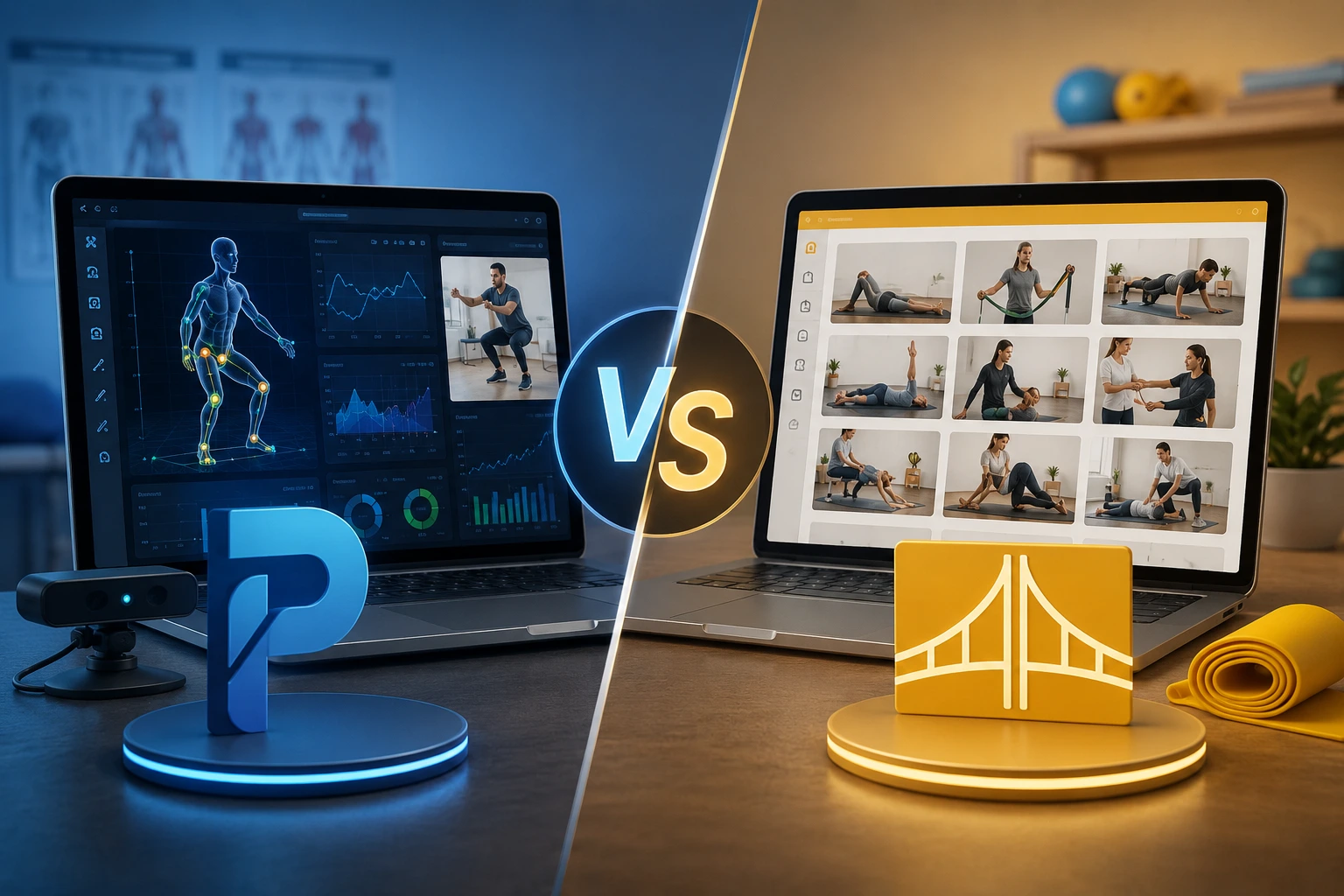
Medbridge and PivotalPT represent two fundamentally different approaches to digital rehabilitation.
In addition to their structural differences, both platforms reflect the broader evolution of digital rehabilitation toward more connected care delivery models.
The choice between them often depends on whether an organization prioritizes workflow efficiency or objective performance measurement.
Clinics focused on standardized patient education and scalable engagement workflows may find Medbridge aligned with their operational needs.
On the other hand, organizations seeking deeper insight into patient movement and functional performance may prioritize platforms like PivotalPT.
The increasing adoption of remote care tools has made both engagement data and performance-based analytics relevant in modern rehabilitation.
As reimbursement models continue to evolve, especially around remote therapeutic monitoring, data transparency and clinical traceability are becoming more important.
Ultimately, the effectiveness of either platform depends on how well it integrates into existing clinical workflows and care objectives.
Both approaches contribute to improving access to care, but they emphasize different dimensions of the rehabilitation process.
PivotalPT
Focuses on:
- Real patient performance analysis
- Objective clinical data
- Biomechanical insights
- Performance-based RTM
- Data-driven clinical decision-making
Medbridge
Focuses on:
- Clinician education
- Patient engagement
- Standardized home exercise programs
- Workflow-based care delivery
Key Takeaway
The core difference between these platforms is:
PivotalPT = performance-based, objective clinical intelligence platform
Medbridge = education, engagement, and workflow-driven care platform
FAQs (Frequently Asked Questions) about PivotalPT and Medbridge
1. What is the main difference between Medbridge and PivotalPT?
PivotalPT focuses on objective performance data and biomechanical analysis, while Medbridge focuses on patient engagement, education, and workflow-based care delivery.
2. Does PivotalPT support remote therapeutic monitoring (RTM)?
Yes, PivotalPT provides objective RTM based on real patient performance and adherence tracking.
3. How many exercises does Medbridge offer?
Medbridge offers more than 8,000 home exercise programs across multiple rehabilitation disciplines.
4. Can exercises be customized in PivotalPT?
Yes, PivotalPT allows clinicians to create fully custom exercises and personalized treatment programs.
5. Which platform focuses more on clinical performance analysis?
PivotalPT focuses more on clinical performance analysis through objective data, biomechanics, and movement tracking.