•
2026/05/02•HEMSCap Content Writer
Digital Movement Assessment : How Technology is transforming physical therapy and rehabilitation
Introduction
Accurate Movement evaluation is one of the foundations of effective treatment in physical therapy, rehabilitation, sports recovery and musculoskeletal care. Clinicians need to understand how a patient moves, where limitations exist and whether treatment plans are producing measurable progress.
Traditional movement assessment methods often rely on visual observation, manual measurements, or expensive lab-based systems. While professional experience remains essential, these methods may be time-consuming and difficult to standardize.
Today, Digital Movement Assessment is changing that process through artificial intelligence, computer vision, and data-driven analytics. These technologies make movement evaluation faster, more objective, and in many cases accessible remotely.
In this article, we will explore what Digital Movement Assessment is, how it works, why it matters, and how companies such as HEMSCAP are contributing to the future of physical therapy and rehabilitation.
What Is Digital Movement Assessment?
Digital Movement Assessment refers to the use of digital tools to analyze and evaluate human movement. These tools may include cameras, mobile devices, AI software, motion analysis platforms, and computer vision systems.
The goal is to measure factors such as joint mobility, posture, balance, gait quality, movement symmetry, and functional performance. Unlike purely observational methods, digital systems can provide measurable data that supports better clinical decisions.
Why Traditional Movement Assessment Has Limitations
Many healthcare providers still depend heavily on manual observation. While clinical expertise is valuable, traditional approaches can present challenges.
Subjective Interpretation
Two professionals may assess the same movement differently. This can lead to variations in treatment planning or progress tracking.
Limited Quantitative Data
Without digital tools, detecting small improvements or subtle movement deficits may be more difficult. Objective numbers are valuable for comparison over time.
Time-Consuming Workflow
Manual measurements and handwritten notes can reduce efficiency. Busy clinics often need faster systems without sacrificing quality.
How Digital Movement Assessment Works
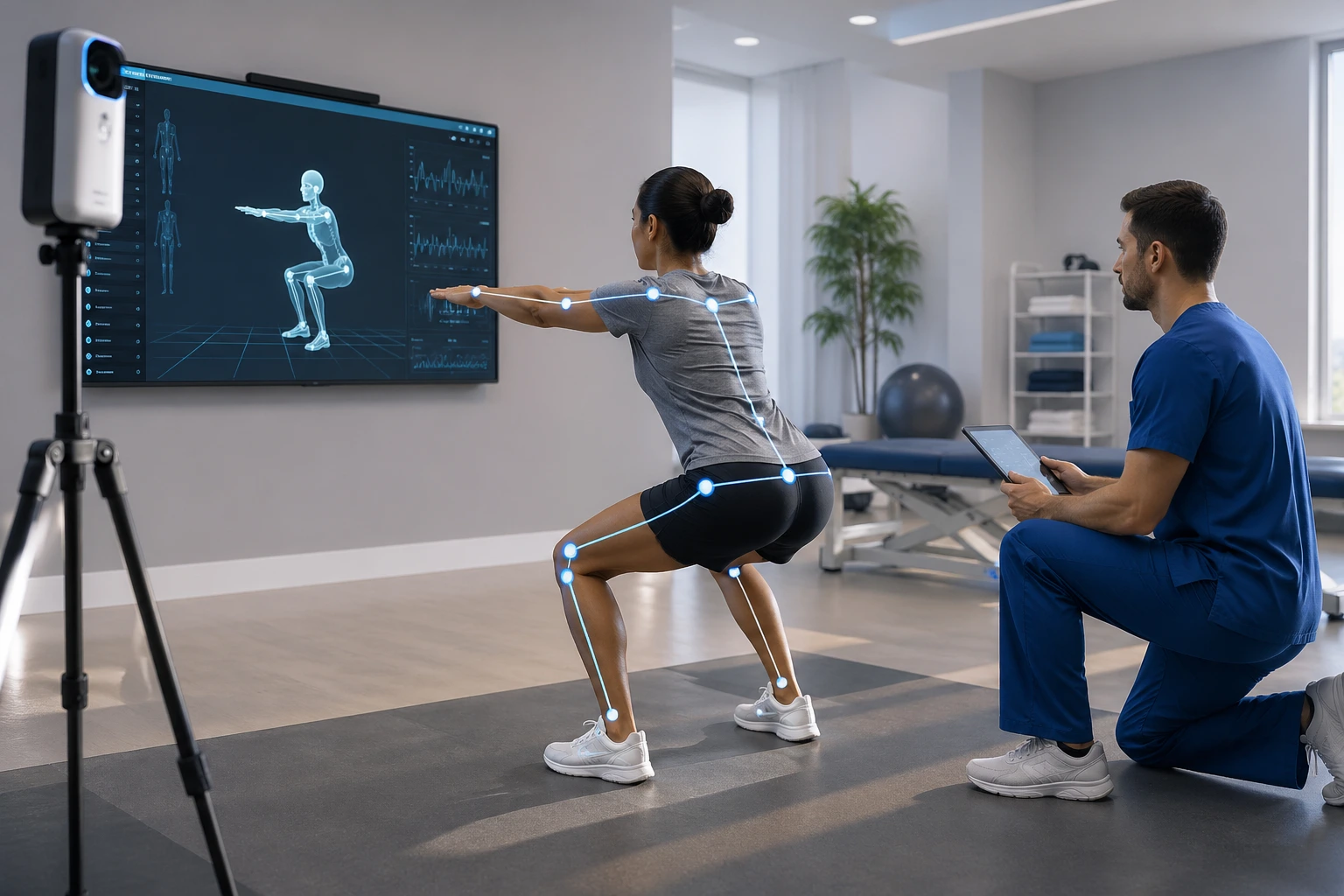
Most modern systems use a camera, smartphone, tablet, or laptop to capture movement. AI algorithms then identify body landmarks and analyze motion patterns.
Typical Process
- Movement Capture
The patient performs a specific task such as squatting, walking, lifting an arm, or balancing. Video is recorded in seconds for later analysis.
- Joint and Landmark Detection
The software identifies body points such as shoulders, hips, knees, ankles, and elbows. This creates the foundation for accurate measurement.
- Motion Analysis
The platform calculates metrics such as range of motion, speed, stability, alignment, and movement symmetry. These values help guide treatment decisions.
- Reporting and Progress Tracking
Results are presented through dashboards, charts, or simple summaries. Clinicians can compare sessions and monitor progress more effectively.
Key Benefits of Digital Movement Assessment
This technology offers practical advantages for both providers and patients.
Better Clinical Accuracy
Objective measurements help clinicians understand limitations more precisely. This supports smarter treatment planning and more confident decisions.
Progress Monitoring
Small improvements in mobility, posture, or control can be documented over time. Patients often feel more motivated when progress is visible.
Remote Care Opportunities
Patients can complete movement checks at home using a mobile device. This makes telehealth and hybrid care models more effective.
Greater Efficiency
Automated workflows reduce time spent on manual tasks. Providers can dedicate more attention to patient care and communication.
Applications in Physical Therapy
Physical therapy is one of the strongest use cases for Digital Movement Assessment.
Shoulder and Neck Conditions
Limited overhead movement, reduced rotation, or postural dysfunction can be measured more accurately. This improves exercise selection and treatment progression.
Knee and Hip Recovery
After injury or surgery, gait quality, sit-to-stand movement, and balance can be evaluated consistently. This helps guide safe return to activity.
Home Exercise Programs
Patients can perform exercises remotely while receiving movement feedback. Better guidance often improves adherence and outcomes.
The Role of HEMSCAP in Digital Movement Assessment
HEMSCAP is one of the companies operating in the digital rehabilitation and movement analysis space. Its focus includes AI-powered solutions for physical therapy, movement tracking, and remote care.
The company highlights the use of computer vision technology to assess movement without requiring complex wearable sensors. This approach can reduce barriers to adoption and make movement analysis more accessible for clinics and patients.
HEMSCAP also promotes tools related to home exercise engagement, progress visibility, and digital care delivery. These areas are increasingly important as healthcare moves toward hybrid and remote treatment models.
Why Data-Driven Rehabilitation Matters
Rehabilitation is most effective when decisions are based on measurable evidence. Digital Movement Assessment helps providers move beyond assumptions and rely on real performance data.
When a clinician can see exactly how much shoulder motion improved in two weeks or whether walking symmetry changed after treatment, care becomes more precise and outcome-focused.
This data-driven approach can also improve communication with patients, referring physicians, and payers.
Research Supporting Digital Movement Analysis
Academic research has shown growing interest in markerless motion capture and computer vision systems for clinical movement analysis. These technologies are being studied for their ability to improve accessibility while reducing the cost and complexity of traditional motion labs.
The Future of Digital Movement Assessment
The next generation of movement analysis will likely become smarter, faster, and more integrated into everyday healthcare.
Important Trends
- Personalized AI Insights
- Future systems may adapt assessments based on age, injury history, goals, and performance level. This can create more individualized care plans.
- Integration With Health Records
- Assessment results may automatically sync with digital medical records. This improves documentation and continuity of care.
- Expanded Home Monitoring
- Patients may complete regular movement screenings without frequent clinic visits. This is especially valuable for older adults and rural populations.
- Broader Preventive Care Use
- Movement screening may become part of wellness programs, workplace health, and injury prevention strategies.
Final Thoughts
Digital Movement Assessment is more than a technology trend. It represents a major shift in how movement is measured, monitored, and improved.
For physical therapy clinics, rehabilitation centers, and digital health providers, this approach offers greater accuracy, better patient engagement, and stronger clinical efficiency. It also supports the growing demand for remote and hybrid care.
Companies such as HEMSCAP reflect how the industry is moving toward smarter, data-driven rehabilitation solutions. As adoption continues, Digital Movement Assessment is likely to become a standard part of modern care delivery.
FAQ
1. What is Digital Movement Assessment?
It is the use of digital tools such as cameras and AI software to evaluate human movement. The goal is to improve accuracy, tracking, and treatment decisions.
2. Does Digital Movement Assessment require wearable sensors?
Not always. Many modern systems use camera-based computer vision and do not require wearable devices or markers.
3. Is Digital Movement Assessment useful for physical therapy?
Yes. It can help measure range of motion, movement quality, exercise form, and patient progress over time.
4. What does HEMSCAP do in this field?
HEMSCAP develops AI-based solutions focused on movement analysis, physical therapy support, and remote rehabilitation tools.
5. Will this technology replace clinicians?
No. It is designed to support clinicians by improving measurement, efficiency, and decision-making—not replace professional expertise.