•
2026/04/23•HEMSCap Content Writer
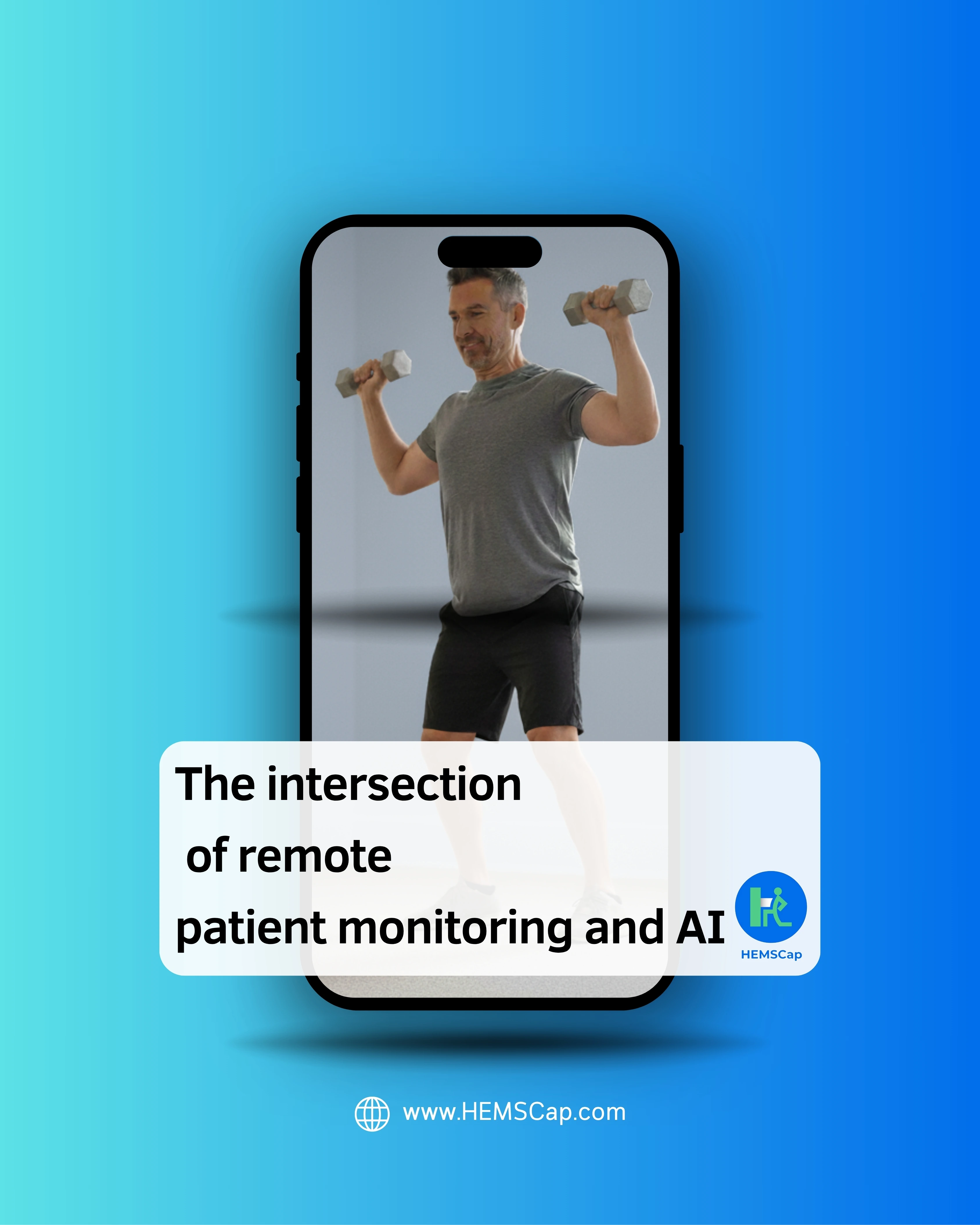
The intersection of remote patient monitoring and AI
The Intersection of Remote Patient Monitoring and AI
Healthcare is undergoing a significant transformation as artificial intelligence (AI) and remote patient monitoring (RPM) increasingly converge. This intersection is redefining how clinicians interact with patients, how data is collected, and how care is delivered beyond traditional clinical settings.
Remote patient monitoring has already changed the healthcare landscape by enabling providers to track patient health data outside of hospitals and clinics. Through connected devices and digital platforms, clinicians can monitor vital signs, symptoms, and recovery progress in real time. However, the growing volume of data generated by RPM systems has created a new challenge: how to efficiently interpret and act on this information.
This is where artificial intelligence plays a critical role.
AI technologies are capable of processing large-scale patient data streams in real time, identifying patterns that may not be immediately visible to healthcare providers. By analyzing continuous inputs from RPM systems, AI can help detect early warning signs, predict potential complications, and support more timely clinical interventions.
One of the most important benefits of combining AI with remote monitoring is improved clinical decision-making. Instead of relying solely on periodic check-ins or manual data review, clinicians can access intelligent insights that highlight meaningful changes in a patient’s condition. This allows for faster responses and more proactive care strategies.
Another key advantage is personalization. Every patient generates unique health data patterns, and AI systems can learn from these patterns over time. This enables more tailored treatment plans that adapt dynamically to a patient’s progress, rather than relying on static protocols. As a result, care becomes more precise, efficient, and patient-centered.
The integration of AI and RPM also improves healthcare accessibility. Patients can be monitored continuously in their homes, reducing the need for frequent in-person visits. This is especially valuable for individuals with chronic conditions, post-surgical recovery needs, or mobility limitations. It also helps reduce the burden on healthcare facilities by optimizing resource allocation.
Despite these benefits, the integration of AI and remote monitoring also requires careful consideration of data privacy, system interoperability, and clinical validation. Ensuring that AI-driven insights are accurate, explainable, and clinically relevant is essential for widespread adoption.
Looking ahead, the combination of AI and remote patient monitoring is expected to become a foundational element of modern healthcare systems. As technology continues to evolve, this integration will likely expand beyond monitoring and into predictive and preventive care models, shifting healthcare from reactive treatment to proactive health management.
Ultimately, the convergence of AI and RPM represents a major step toward a more connected, data-driven, and intelligent healthcare ecosystem—one where patients receive continuous, personalized care regardless of location.